

The fast and furious evolution of B2B payments in recent years has created the impression that technology has solved most of the problem. In reality, what looks seamless on the surface still carries a great deal of complexity underneath. Backend bottlenecking cries out for solutions.
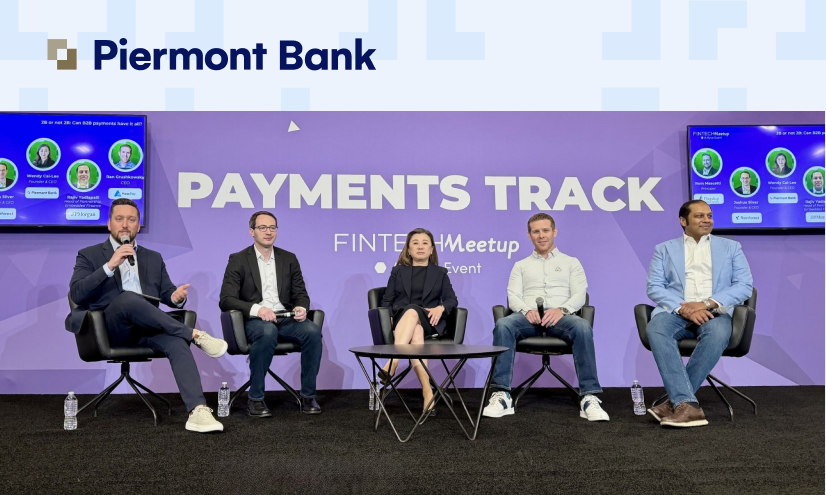
At Fintech Meetup 2026 in late March, Piermont Founder and CEO Wendy Cai-Lee explored this paradox, unpacking why something that appears straightforward is anything but. The issue isn’t how fast money moves—it’s that trust doesn’t move with it.
Cai-Lee pointed out that real-time rails and embedded finance have transformed how payments are executed. But behind that progress sits a more persistent constraint: trust, identity and accountability within each transaction. Drawing from Piermont Bank’s experience in end-to-end practice, we believe “programmable trust” will define the next phase of B2B payments.
Payments are easy. Validation is not.
Unlike consumer transactions, B2B payments are never just payments. Every transaction carry context such as an invoice, an approval chain, a contract, tax treatment, and ultimately reconciliation.
The payment itself is the final step. What takes time is validating who you’re paying, why you’re paying, and whether the transaction is legitimate.
Today, that validation still relies on fragmented systems and manual processes—emails, PDFs, and human approvals. The payment itself is the easiest part—the validation is not. As Cai-Lee noted: “these are not simply inefficiencies; they are workarounds for a missing layer of infrastructure”.
A new operating model with an old constraint
The past few years have brought a structural shift in how payments are initiated.
Banking has been unbundled. Payments are increasingly originated through fintech platforms, marketplaces and embedded experiences that sit outside the bank. Customer relationships have moved. Interfaces are distributed.
But accountability has not.
Regulators still expect the bank to understand and oversee the customer, the activity and the risk—end to end.
This creates a persistent tension: execution is distributed across multiple players, but accountability remains centralized.
Without shared infrastructure for identity, data and controls, trust is no longer embedded into the transaction itself. Instead, it is reconstructed—through monitoring, manual reviews, and limits that reintroduce friction.
Faster can become riskier
Innovation has accelerated across embedded finance, cross-border payments, and emerging models like stablecoins. But these advances primarily optimize how money moves—not how it is trusted. This remains one of the biggest, yet often overlooked, sources of friction in B2B payments today.
Faster settlement does not answer critical questions: Is the counterparty legitimate? Is the payment authorized? Does it meet regulatory expectations?
In some cases, speed increases exposure. The faster money moves, the less time there is to validate it.
“The industry doesn’t have a settlement speed problem—it has a trust and control challenge,” said Cai-Lee at the B2B Payment panel of the Fintech Meetup.
SMB gains access but not control
These changes are not affecting all businesses equally.
Large enterprises are capturing efficiency gains—faster settlement, optimized treasury operations, and lower costs at scale. Small and mid-sized businesses are gaining access to tools that were previously unavailable, including embedded payments and working capital.
But access comes with trade-offs.
SMBs often have less visibility into how transactions are processed and where risks sit across platforms. They benefit from inclusion but also take on more complexity and exposure.
“We’ve democratized access—but we haven’t fully democratized control,” Cai-Lee pointed out.
The next phase of B2B payments: fast and trusted payments
If speed is no longer the primary challenge, what comes next?
The future of B2B payments lies in building a trust layer directly into the transaction.
It begins with identity. Today, a single business can appear differently across ERP systems, banks and fintech platforms. A portable, verified identity layer—one that travels with the transaction—would reduce both friction and fraud.
It also requires connecting payments to their underlying workflows. In most systems, invoices, approvals and payments remain loosely linked, requiring manual reconciliation. A more integrated model would allow payments to carry their own context, linking authorization, purpose and execution in a single flow.
The next phase will be about modernizing the trust infrastructure that sits on top of them. The institutions that embrace this shift will not just move money faster. They will define what trusted payments look like in the digital economy.